

Upholstery leather has become popular with bag-makers for one simple reason: it looks great. It’s soft, colorful, widely available, and often more affordable than traditional veg-tan or bridle leather. But upholstery leather is not bag leather by default, and that’s where beginners get into trouble.
If you understand its strengths and reinforce it properly, upholstery leather can make beautiful, durable purses and bags. If you don’t, you’ll end up with sagging sides, stretched handles, and a bag that looks tired before it ever leaves the house.
Let’s talk about how to do it right.

What Upholstery Leather Is (and Isn’t)
Upholstery leather is designed for furniture, not structure. It’s typically:
-
Chrome-tanned
-
Soft and pliable
-
Stretch-prone
-
Finished or coated on the surface
That makes it comfortable and attractive—but also means:
-
It won’t hold shape on its own
-
It won’t burnish like veg-tan
-
It needs internal support to behave like a bag
Think of upholstery leather as a skin, not a frame.
Why Reinforcement Is Non-Negotiable
If you skip reinforcement, your bag will:
-
Slouch
-
Stretch at stress points
-
Sag at the bottom
-
Pull apart at straps and hardware
Reinforcement isn’t optional—it’s the difference between a hobby project and a product that lasts.
How to Reinforce Upholstery Leather Properly
1. Use a Structural Liner
Most successful upholstery-leather bags rely on an internal layer to provide strength.
Common options:
-
Canvas duck – traditional, breathable, strong
-
Cotton twill – good balance of structure and flexibility
-
Decovil Light or similar fusible stabilizers – adds body without stiffness
-
Thin veg-tan or firm leather panels – ideal for bases and gussets
Avoid floppy quilting cottons unless paired with something stronger.
2. Reinforce the Bottom (Always)
The bottom of the bag takes the most abuse.
Best practices:
-
Add a hidden base panel (plastic, leather, or stiff interfacing)
-
Double the leather at the base
-
Use a liner that wraps continuously around the bottom
A saggy bottom screams “homemade.”
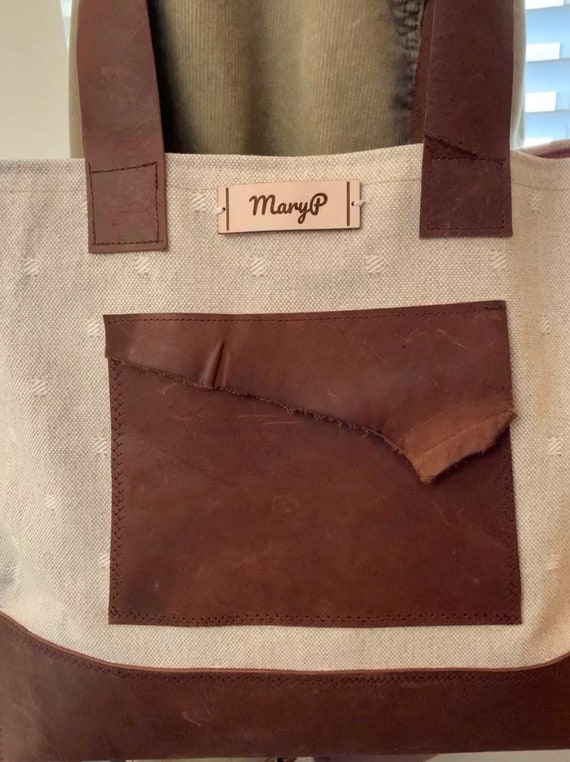
3. Stabilize Straps and Handles
Upholstery leather stretches. Gravity never quits.
To prevent strap failure:
-
Sandwich webbing, nylon strapping, or firm leather inside handles
-
Avoid single-layer leather straps
-
Stitch multiple rows for load-bearing areas
If the strap stretches, the bag is done.
4. Reinforce Stress Points
Anywhere hardware attaches needs extra support.
That includes:
-
D-rings
-
Rivets
-
Magnetic snaps
-
Zippers
Add hidden reinforcement patches inside the bag. This is old-school leather wisdom for a reason—it works.
Can You Sew Upholstery Leather on a Regular Sewing Machine?
The honest answer: Yes—within limits.
A standard home sewing machine can handle upholstery leather if you respect its boundaries.
What You’ll Need:
-
Leather or microtex needles (size 90/14 or 100/16)
-
Longer stitch length (3.5–4 mm)
-
Polyester upholstery thread (not cotton)
-
Walking foot or Teflon foot (strongly recommended)
What to Avoid:
-
Sewing through too many layers
-
Forcing thick seams
-
Backstitching repeatedly in the same hole
-
Using pins (they permanently mark leather)
If your machine struggles, listen to it. Burned motors and skipped stitches are warning signs.
When a Home Machine Is Not Enough
You’ll hit the wall when:
-
Sewing reinforced straps
-
Stitching boxed corners
-
Attaching thick handles
-
Sewing through leather + liner + stabilizer + hardware layers
At that point, you either:
-
Redesign to reduce bulk
-
Hand-finish problem areas
-
Or move up to a walking-foot or industrial machine
There’s no shame in limits. Craftsmen have always chosen tools that match the job.
Common Mistakes Beginners Make
-
Expecting upholstery leather to behave like veg-tan
-
Skipping reinforcement to “keep it soft”
-
Using decorative fabric liners with no structure
-
Making single-layer straps
-
Fighting the sewing machine instead of redesigning
Good leatherwork is planning, not brute force.
Final Takeaway
Upholstery leather can make excellent purses and bags—but only if you build structure into the design. The leather provides beauty and feel. The reinforcement provides longevity and function.
That’s the traditional truth:
Leather shows the work. It never hides shortcuts.